- Published on
[Dev Log] The Coroutine Deception: Single-Threaded Traps Masquerading as Async
- Authors
- Name
- Logan Kim
Subtitle: Why I Don't Trust Unity's "Do-It-All" Tool
As discussed in my previous post, I ultimately broke free from the lock-in of expensive SaaS and completely overhauled the infrastructure to a FishNet-based Host-Dedicated mixed architecture. While financially efficient, this structure brings an architectural homework: to prevent data tampering, I had to implement fairly heavy encryption and integrity validation logic (Security Modules) directly on the client side.
When the need for such "heavy background calculations" or wait times arises in Unity's single-threaded ecosystem, developers habitually call upon what is treated as a silver bullet: StartCoroutine().
The code looks clean, and it feels as though an elegant asynchronous process is running in the background. But from an architect's perspective, the coroutine is little more than a cheap magic trick that masks the reality of how asynchronous processes actually work.
1. The Illusion of Async (Node.js vs. Unity Coroutine)
The moment you mount a massive security module or throw complex mathematical operations onto a coroutine, the game inevitably stutters. This is because coroutines look like async, but they are fundamentally a deceptive structure running entirely on a single thread.
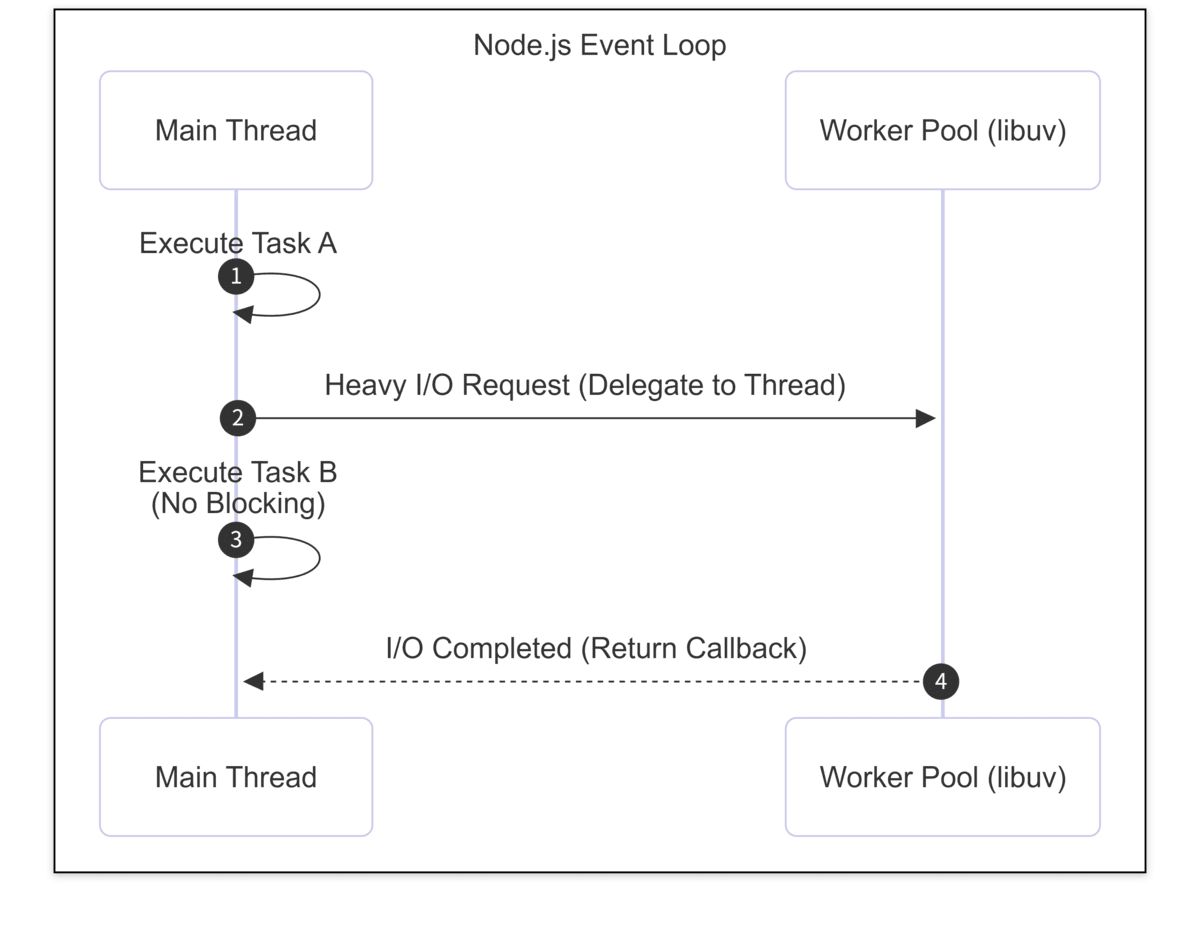
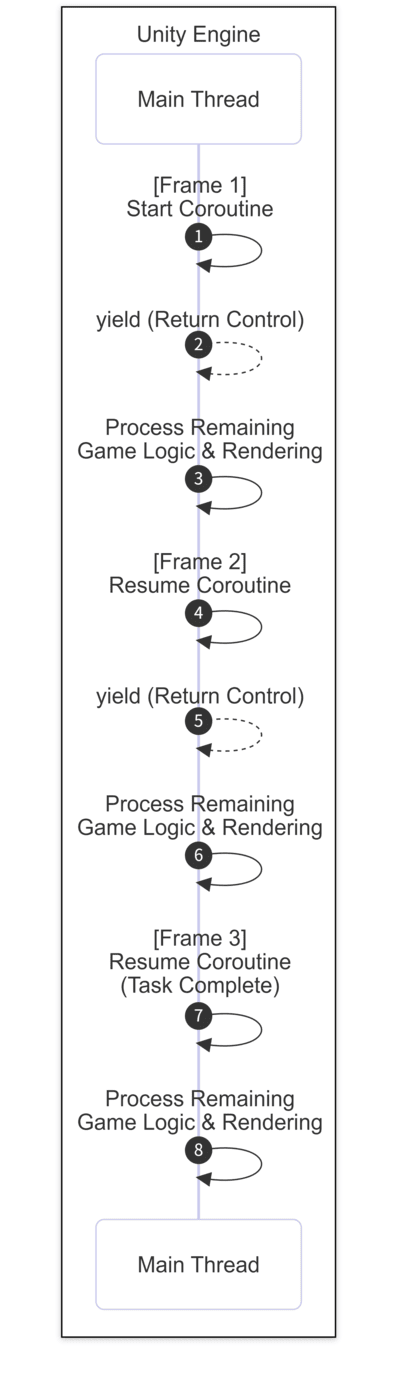
To clarify, let’s look at a schematic comparing the event loop of Node.js (a true single-threaded async runtime) and Unity Coroutines.
Node.js : Real Async (Thread Delegation)
Unity Coroutine : Time-Slicing Illusion
When Node.js encounters a heavy task, it performs a "real delegation" by tossing the workload to a background thread pool (like libuv). The main thread doesn't pause; it immediately executes the next line of code and simply receives a callback when the background task finishes.
Unity Coroutines are fundamentally different. They are strictly bound to the main thread. The yield return statement doesn't delegate work anywhere; it simply says, "I'll only calculate up to this point for this frame, and I'll come back next frame," handing control back to the main loop. It is a shallow time-slicing trick.
It is no different from the cooperative multitasking used back in the Windows 3.1 era. In an MMORPG architecture, where you must handle massive data synchronization and hundreds of concurrent connections, running a heavy while loop or complex algorithm inside a coroutine takes the entire main thread hostage, causing your framerate to plummet into the abyss.
2. The Swamp of Garbage Collection (GC)
An even more fatal issue is memory waste.
Executing a coroutine intrinsically means allocating a C# IEnumerator state machine object onto the Heap.
// The worst kind of code written purely out of habit
IEnumerator AttackRoutine() {
    yield return new WaitForSeconds(0.5f);
    // ...
}
Imagine the code above executing simultaneously across hundreds of characters on a server or client. Every time that new keyword is called, garbage accumulates. The moment the Garbage Collector (GC) intervenes to clean up the mess, the main thread violently spikes again. The GC pressure caused by allocating IEnumerator objects is a cost that can never be ignored in large-scale systems.
3. Breaking the Illusion and Returning to the Metal
Ultimately, to build a proper system, you must break out of the "fake async" illusion.
If you are just doing simple UI transitions or lightweight timers, a coroutine is an acceptable choice. But if you need to offload heavy logic from the main thread, you must implement true multi-threading (like C# Tasks or Unity's Job System), or step outside Unity's fences entirely by pushing the logic down to the Native (C++) level via FFI (Foreign Function Interface) to control the multi-cores directly.
The recent trend of "Vibe Coding"—just riding the flow and loosely stringing code together—might be enough to get pixels moving on a screen today.
But eventually, a time comes when you have to strip away that lightweight romance and seriously examine the skeleton of your system. The moment you step onto the battlefield of "optimization," where you must squeeze every drop of performance out of limited resources, is that time.
I may not have a long resume exclusively in game engines, but I have spent 16 years architecting massive distributed systems and server infrastructures from the ground up. If there is one principle I have carved into my bones, it is this: